Running Form
This paper by van Oeveren et al.[1] is one of my favorite papers of all time. It demystified running form for me, compressing the biomechanics into their core primitives: step length & duty factor:*
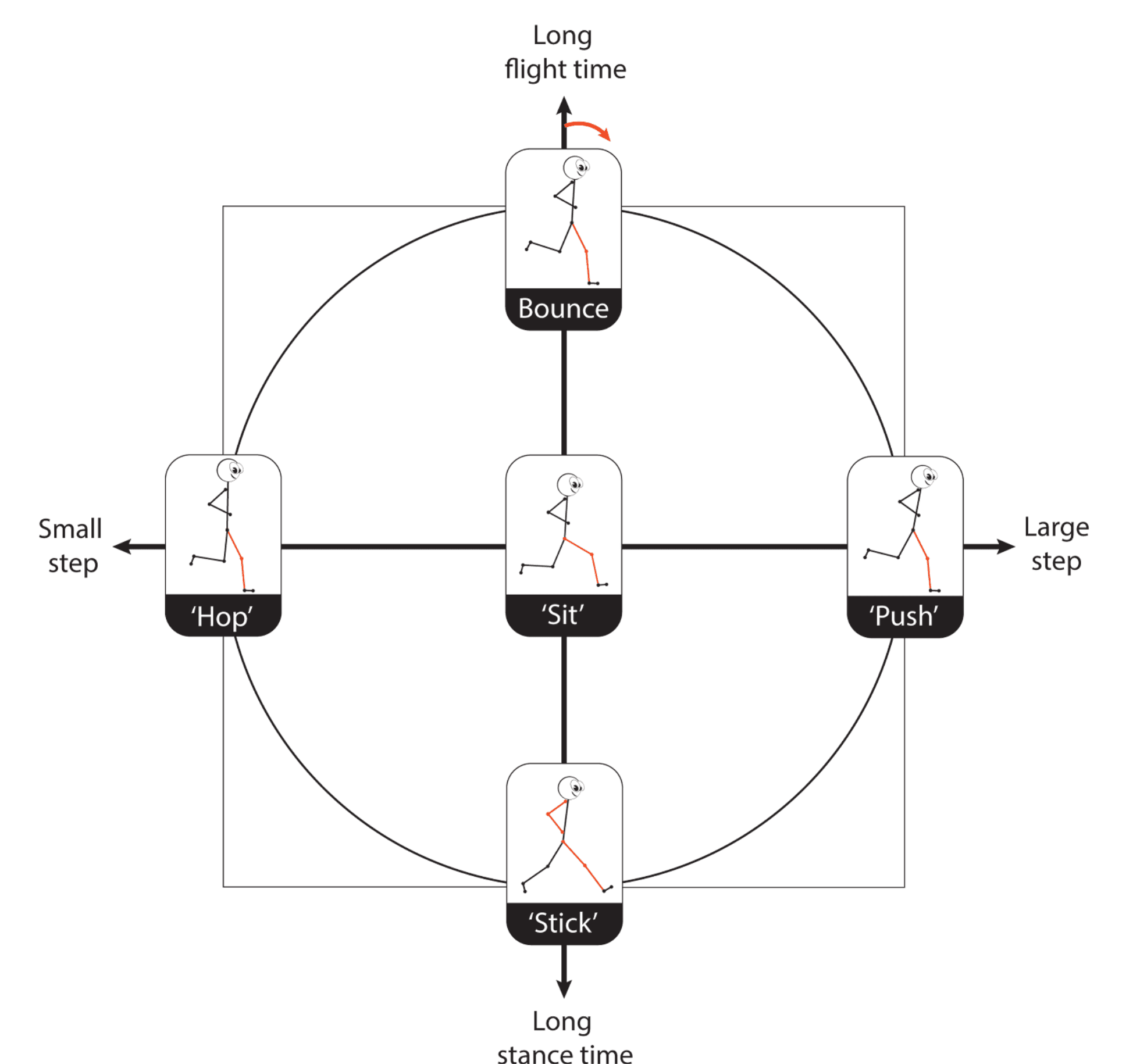
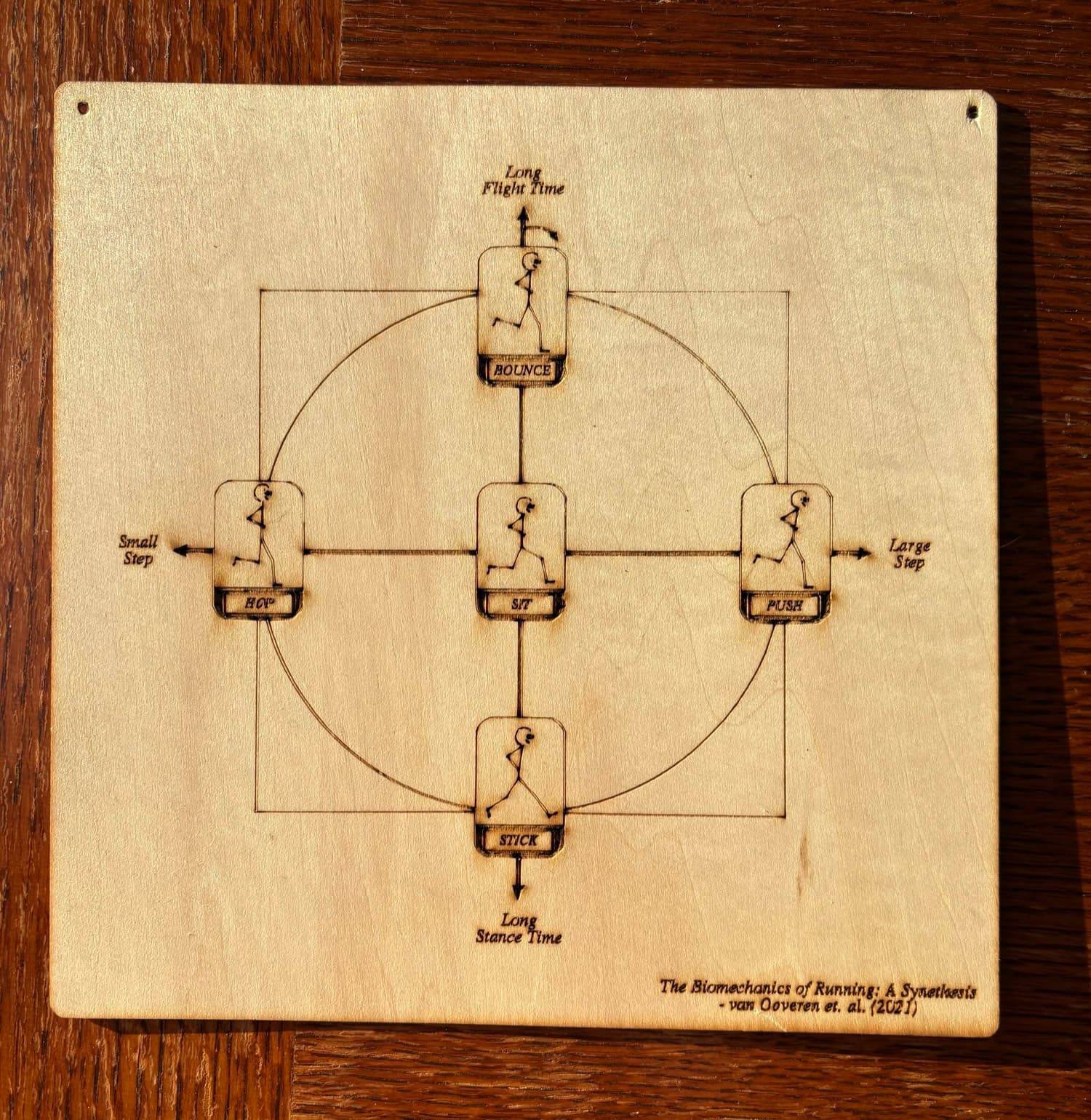
I loved it so much I had to give it the ole laser cutter treatment, turning it into a poster for my office:
But I knew I could do better. It's hard to conceptualize different running forms from still images. So I brought them to life!:
What's the point? Running with better form can lighten the load your joints take on every step, and potentially even reduce your injury risk.
If there's one metric you should care about - it's cadence. Though the evidence is mixed, one study found that increasing your cadence by 5-10% can cut the energy your knees have to absorb on each landing by 20-34%[2]. And if you're a newer runner, a quicker cadence may be more oxygen-efficient [3]. To calculate your "ideal" target cadence (or at least, one that's probably good enough) - check out this cadence calculator.
Ryan YostJuly 30th, 2026
* normalized by leg length, while keeping speed fixed.
- [1]van Oeveren, B. T., de Ruiter, C. J., Beek, P. J., & van Dieën, J. H. (2021). The biomechanics of running and running styles: a synthesis. Sports Biomechanics, 23(4), 516–554.
- [2]Heiderscheit, B. C., Chumanov, E. S., Michalski, M. P., Wille, C. M., & Ryan, M. B. (2011). Effects of step rate manipulation on joint mechanics during running. Medicine & Science in Sports & Exercise, 43(2), 296–302. University of Wisconsin–Madison.
- [3]de Ruiter, C. J., Verdijk, P. W. L., Werker, W., Zuidema, M. J., & van Dieën, J. H. (2013). Stride frequency in relation to oxygen consumption in experienced and novice runners. European Journal of Sport Science, 14(3), 251–258.